
 In the final race of July 30’s “Under the Lights” event, a significant crash occurred as drivers exited Turn 4 on the SR3 Oval in Segment 5. This crash impacted literally every driver in that segment.
During the crash, the deslotted car in the Blue lane passed under the scoring gantry on its lid, triggering a lap for the driver in the White lane. While still spinning, the car was hit at full speed by the car actually in the White lane, causing that car to de-slot and come to a stop on the Orange lane. That car was then plowed into by the car in the Orange lane at full speed. All of this occurred before the race director halted the race and cut the power.
A lot of very impactful things happened as a result of the Blue lane car deslotting:
-
-
- The Blue lane did not get their lap.
- The spinning Blue lane car triggered an early record lap for the White lane driver.
- The White lane car crashed hard into the slowly but still spinning Blue lane car and de-slotted, coming to a stop in the middle of the Orange lane.
- The Orange lane and Green lane cars both picked up a lap during the crash.
- The Orange lane car then slammed into the White Lane car and also de-slotted with an “Out-of-body” experience.
-
All the above things happened before the power was cut and the segment halted.
As the HOPRA rules below have long supported, the expectation of most drivers present was to allow the Blue lane car to regain its “missed” lap by placing the crashed car behind the scoring gantry, near where it de-slotted, and restarting. Which, as you can see in the video, was attempted.
However, the Orange and Green lane drivers disagreed with the expectation that the Blue lane car should be allowed to regain the lap it had lost.
The general consensus was pretty much a toss-up, and the track owner decided not to count the lap, and the segment and race continued. Of course, the Blue lane driver and others were not pleased with the decision.
The track owner’s reasoning was that allowing the Blue lane car to get the lap back essentially negated any negative impact on the crashing driver while significantly negatively impacting all the other drivers.
Key HOPRA Rule on Missed Laps / De-SlotsFrom HOPRA Racing Rules and Procedures (section covering de-slots and lap counting):
- The only penalty for a de-slot (car coming out of the slot) is the time lost while a marshal replaces it.
- A driver shall not be penalized a loss of lap(s) if their car misses the lap counter due to a de-slot or improper marshalling.
- A driver shall not gain a lap if another car passes over their lap counter for the same reason.
- Recognition of a missed (or extra) lap must come from an official marshal or Race Director.
- If a car misses the counter, the Race Director adds the deserved lap to the driver’s total during or at the end of the segment.
- If a track marshal verifies a missed or added lap, they notify the Race Director to correct the count.
In short, missed laps caused by de-slots or marshaling errors are corrected (added back) rather than left as permanent penalties. The time cost of being off-track is considered sufficient.
The keywords in the HOPRA rules are “The time cost of being off-track is considered sufficient.” In this case, there would be no time cost. Only the laps lost and the distance lost by all three of the other drivers who did not crash.
I’m sure this type of incident has been encountered before and will certainly happen again. To avoid future frustration and anger, a specific rule will be created to properly address this type of situation going forward.
View the video on Rumble here.
Just before this final race got underway, I was thinking to myself how much fun it has been racing with the Thursday Night “Under the Lights” bunch.
It is not fun when folks leave Stewart Raceway angry and/or frustrated.

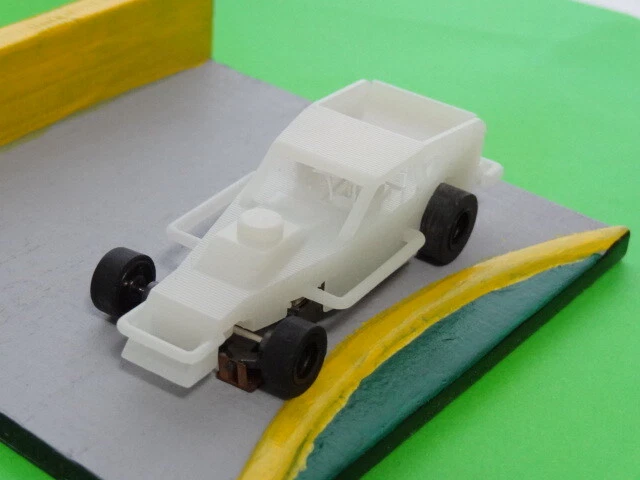
 This mod gives you a significant performance boost and lets you run any Viper Narrow PST Slip-On tire set.
 Brass, Delrin, or Alloy hubs are allowed.
 This is a motor and electronics board available from either Jag Hobbies or Viper. Viper also makes their own replacement motor assembly, which should be available on their site soon.