The SR2 TFX “Box Stock” set is getting expanded for SR3.
It wasn’t long after I decided on a new 6-lane track that I realized I not only had to spend a lot of money on the track but I also had to update my fleet of IROC cars to go with it–Cha-Ching!
Yea, I could stick with the 4-lane fleets I have but that’s no fun. So I’m slowly adding to the house fleets for SR3 while begging Georgie and Kevin to build or bring their 6-lane IROC sets over for us to play with.
The above photo shows the existing SR2 TFX IROC set, which most of us have raced many times. The two cars in the middle are new additions to support SR3’s two extra lanes. Georgie is currently detailing a late-model Camaro body in green and may also detail the orange late-model Camaro shown above. We’ll then have a nice six-car set of box-stock TFX cars to IROC race with on SR3. These cars have the stock Gray Dragon motor magnets and are much looser than the TFX “Lite” class we currently race regularly with.
I’m also adding to my fleet of Jag Hobbies TR-3’s. These cars are pretty cool and showcase the Jag Hobbies Augoran short-wheelbase hardbody, which is a very cool body. The pics here are the orange and green lane cars needed for a complete SR3 set. The cars are basically stock but have Jag double-flange rear hubs and independent front ends.
We’re not likely to race these cars in Round 1 of the coming NASCAR MADness Series but we’ll run them at some point during the series, for sure.
The oval layout is operational and ready for Saturday’s test session.
I ran a few magnet and gravity cars and it feels pretty fluid and fast. It’s not as fluid around the banks as I expected but it’s a lot better than SR2 in that regard.
The cars still straighten out between the banked corners but not as pronounced as SR2. Turns 1 & 4 are sharper than 2 & 3, which makes this oval more challenging than the SR2 oval layout. Some of you have experienced the last corner before the start/finish line, it’s tight and alluring, with a decreasing radius entry that makes getting to the finish line a bit more difficult than SR2.
Anyway, it’s all set for some fast laps this Saturday. Again, we’ll just do a bunch of laps and a race or two to make sure all is good with the timing and fuel management setup. Bring some loose cars as well as your fastest magnet cars, and any six-lane IROC sets you may have.
The difference in lap lengths between each lane is about .78-feet. We’ll have to determine what lane is the fastest and make that the pole position. Yes, there will be staggered starts for all oval races. We’ll also do individual qualifying for the Feature races in the upcoming NASCAR MADness Series, which starts the following Saturday, May 28.
While we didn’t get a full field to shake out SR3, I think we pretty much accomplished the goal of verifying that the Road Course configuration is ready to go racing.
First off, I’d like to thank George Peters, Russ Toy, Kevin Webster, and Jerry Pearson for braving the warm weather and beach traffic to help shake out the new track and provide excellent feedback on the new raceway.
We ran a whole lot of laps with all kinds of cars and did one fuel race to make sure there were no issues with pit-entry detection or other issues. That race was completed without a hitch and all looks good to move on to configuration and testing of the oval layout.
We did discover a very slight power degradation involving two sections of the fabulous Bowman circuit. More than likely just a simple matter of reinstalling power shunt pins between the two sections involved. Surprisingly, SR3 consists of nearly 80-feet of roadway over 22 sections of routed track, but it has been deployed using only two power taps. Brad insisted that I only needed one and all would be good. I decided I’d go with two, just for yucks. Actually, two for the road course and two for the oval, but not more than two in either configuration.
So, everything seemed to work as designed and everyone commented that the track was challenging and very fun. Not sure how many drivers took advantage of the very unique individual lane power supply features, but I know a couple did. This is going to be a key differentiator in terms of testing and tuning. No other track I’ve raced on allows you to run any car, at any voltage, on any lane, at the same time. This allows drivers to test/tune a Viper-Jet (12v) while the driver next to them is testing/tuning a TFX car (18v) in the same session. Think about that one for a bit.
Finally, I’d like to introduce Jerry Pearson to the whole group. Jerry messed with H.O. scale cars back in the sixties–like most of us. He recently got interested in slot cars again and is venturing out into the local slot car scene to find out if it is something he’d like to pursue.
Jerry is a great guy and just might be our next Rookie of the Year. He claims he’s “not competitive.” But he was here for about 3.5 hours and went from mid-10-second early laps to mid 5-second laps in late practice. No, not competitive at all.
I hated to throw Jerry into a race his first time back in the driver’s seat in many, many years but we needed as many drivers as we could muster. He cautiously agreed to help with the test race and had a great time.
All in all, Jerry got the full immersion: drove quite a few different cars, ran a IROC fuel race, and generally took in everything with incredible poise and a big smile. He sent me an email later in the day thanking all of us for a fun and welcoming day and mentioned he’d “see us again.” Hope so, Jerry. We’d love to cut laps with you anytime!
Okay, next Saturday is a “Day on the Oval.” We’ll do a bunch of practice laps, probably an IROC race or two, and make sure the oval config is all set for the upcoming NASCAR MADness Series starting May 28, 2022. NASCAR livery is not required for next Saturday but if you have some cars or IROC sets ready, bring them on!
Phidget 8/8/8 card replacing the “road slug” 0/16/16 card. The 16 card requires a minimum of 16ms under the sensor to trigger. The 888 card only 4ms.
Just a quick update on the Pit-Entry limitations I warned about in my previous update.
I’ve been emailing a support guy at Phidgets in Canada, who has been very helpful. He came up with a couple of IR sensor config options for me to try on their faster 8/8/8 card. I couldn’t get this card to work in previous attempts so went back to their 0/16/16 card and decided to live with that card’s shortcomings.
The first and easiest option he proposed worked amazingly well. A few of us will do some comprehensive testing on Saturday. But in my testing today, it seemed to detect every pit entry I could throw at it. And, to my surprise, it detected six cars entering the pits simultaneously. That indicates that the 8/8/8 card might just work for now on SR3–the 0/16/16 card had trouble detecting three simultaneous pit entries.
Anyway, time will tell, but it does appear that the pit-entry speed limitations on SR3 are removed, which is a good thing. No idea if it’ll support any conceivable “Hail Mary” drop into the pits, but I couldn’t perform an entry that it did not detect.
So, never mind my earlier update post. SR3 pit-entry speed limitations appear to be resolved.
Stewart Raceway is back in business. I’d like to get at least six drivers over for a track day either Saturday, May 14, 2022 or Saturday, May 21, 2022.
We need to run the new track through the paces and make sure everything works as expected, barriers are solid and in the proper places, and no gremlins exist. The first track day will be on the road course. You’ll want to make this track day or the very next to get used to the different pit-entry style on SR3. I also want to run a 25-30 lap race on SR2 to make sure the intermittent pit entry miss is resolved there.
Hopefully, we can get enough guys over on the 7th to flush out the road course. If so, we’ll do the same thing the following Saturday to flush out the oval course. The first “official” race of our next series is slated for Saturday, May 28, 2022. Details to follow soon…


 I’m also adding to my fleet of Jag Hobbies TR-3’s. These cars are pretty cool and showcase the Jag Hobbies Augoran short-wheelbase hardbody, which is a very cool body. The pics here are
 the orange and green lane cars needed for a complete SR3 set. The cars are basically stock but have Jag double-flange rear hubs and independent front ends.
 The oval layout is operational and ready for Saturday’s test session.
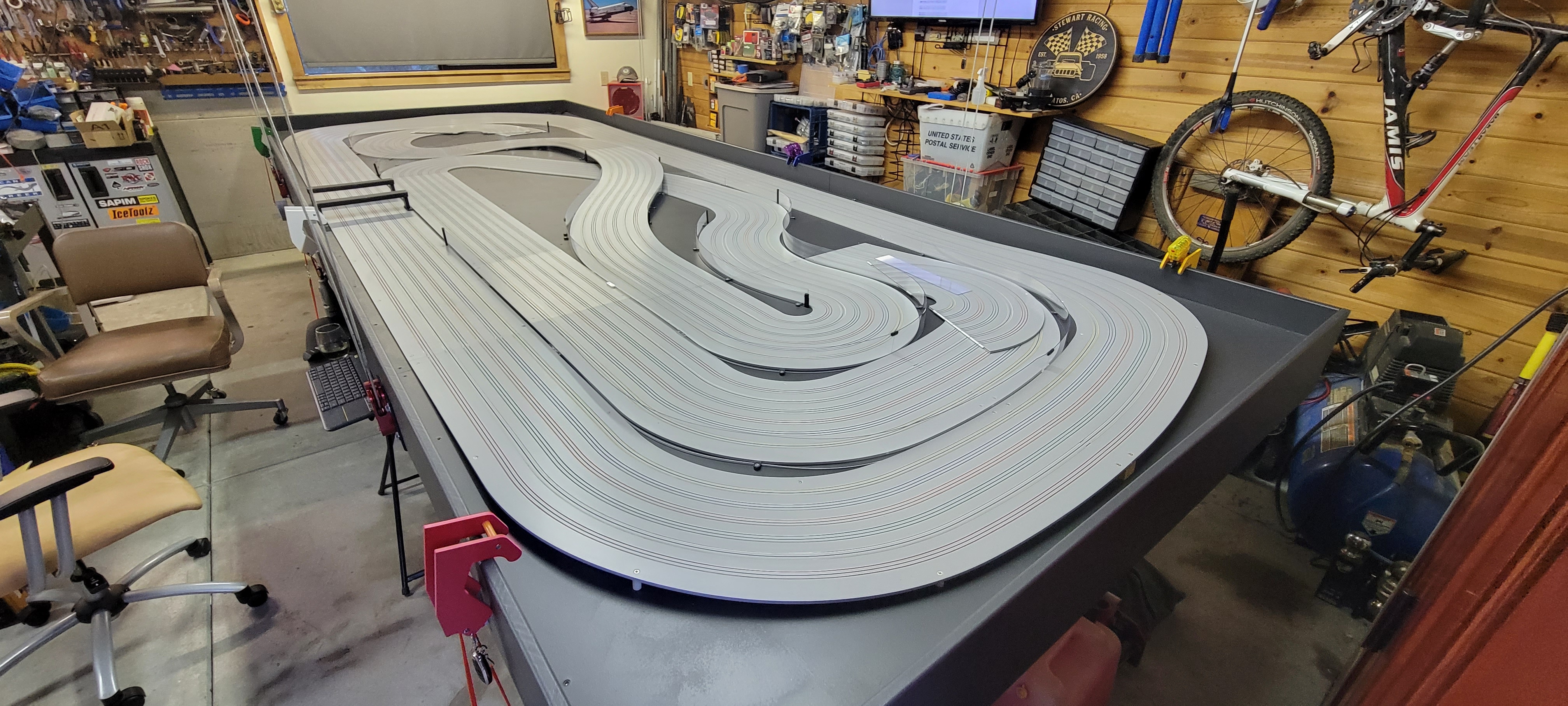 I ran a few magnet and gravity cars and it feels pretty fluid and fast. It’s not as fluid around the banks as I expected but it’s a lot better than SR2 in that regard.
 The cars still straighten out between the banked corners but not as pronounced as SR2. Turns 1 & 4 are sharper than 2 & 3, which makes this oval more challenging than the SR2 oval layout. Some of you have experienced the last corner before the start/finish line, it’s tight and alluring, with a decreasing radius entry that makes getting to the finish line a bit more difficult than SR2.

 Stewart Raceway is back in business. I’d like to get at least six drivers over for a track day either Saturday, May 14, 2022 or Saturday, May 21, 2022.